
CU helped the Lower Chautauqua neighborhood grow and flourish
By Silvia Petem
This year marks the University of Colorado's 150th anniversary. It's a good time to reflect on CU's along with the Lower Chautauqua neighborhood to the south. Proximity to CU allowed the area to grow past, and flourish.
Prior to 1876, when the University was founded, the land it would be built upon was open prairie. When
CU first opened its doors in 1877, the University Building (later renamed Old Main) was the university.
Still standing today, the building contained everything from classrooms and a library to housing for
President Joseph Sewall and his family.
Boulder's population, at the time, was approximately 3,000. Only 44 high school preparatory students
attended classes that first year, as none had passed the university's entrance exam. The following year,
10 of those students formed CU's first freshman class.
By 1884, enough funds had been raised to build the President's House (now Koenig Alumni Center).
In addition, the university grew to include a hospital building and two cottages used as dormitories for
women and, later, for medical students.
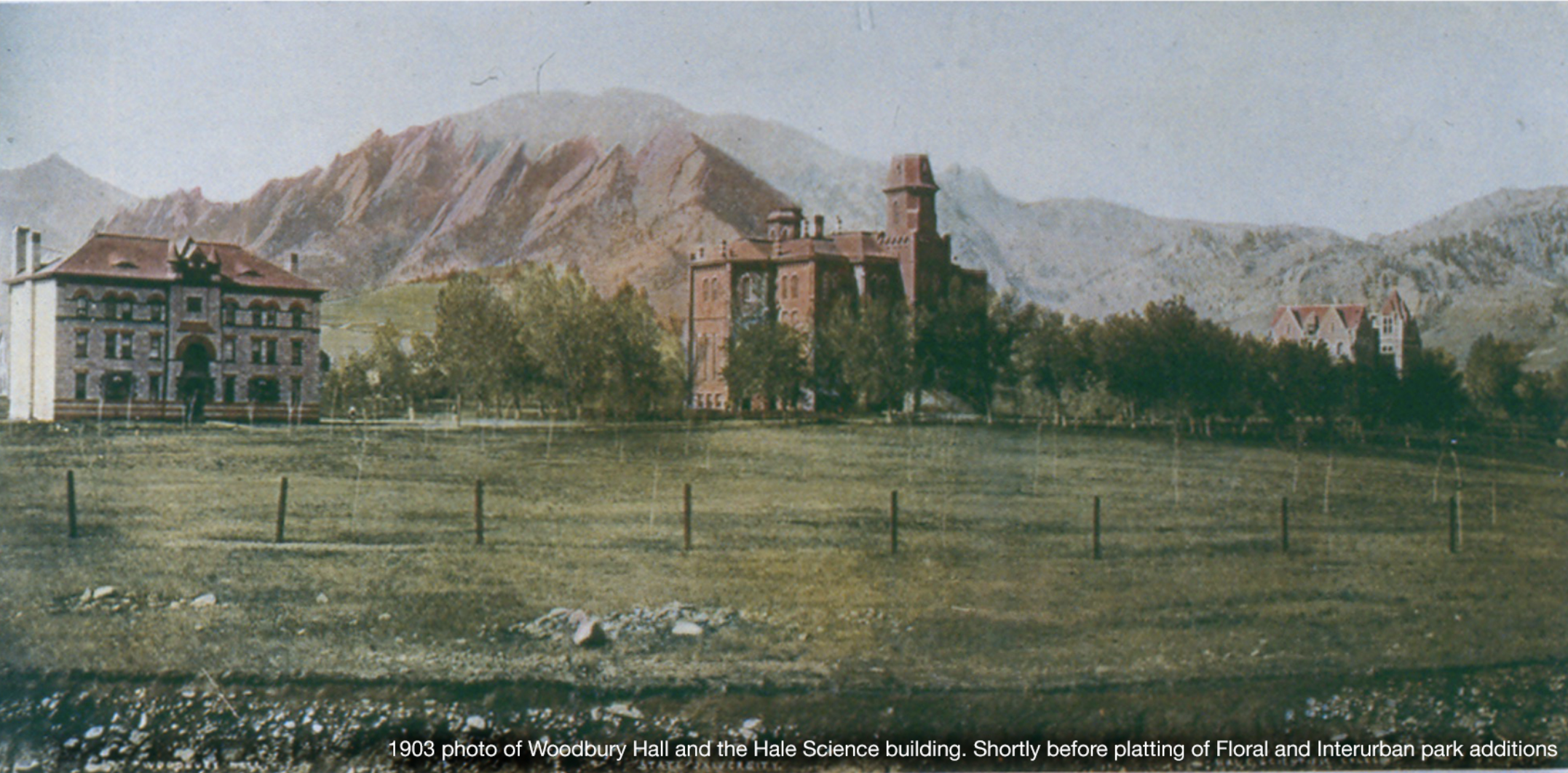
Farsighted administrators planted saplings, and, gradually, the trees grew to provide shade. Woodbury
Hall (a men's dormitory) was constructed in 1890, followed, a few years later, by the Hale Science
building. By the turn of the 20th century, CU's campus began to look like a university.
Land to the south, however, was still barren. As CU's campus grew, so did the city. Beginning in 1905,
Boulder real estate developer David E. Dobbins sold lots in his newly platted Interurban and Floral (likely
named for his wife, Flora) park additions in today's Lower Chautauqua neighborhood. According to
Dobbins' advertisements in the Daily Camera, his sales pitch for the lots included their proximity to the
University of Colorado.
Dobbins also advertised "fruit and dairy tracts," encouraging his buyers not only to build homes, but also
to plant trees and raise cows and chickens. Along with touting the appeal of country living, he added that
his tracts/lots came with the conveniences of the city, including city water and graded streets.
In 1906, lots measuring 50' × 135' were advertised for $150 to $350. In 1908, an electric train (the
Interurban) connected Denver and Boulder, including a convenient stop on Broadway.
One has to wonder, however, why Dobbins, himself, didn't stay in Boulder. According to the 1910 federal
census, the Missouri native moved, at the time, to Los Angeles where he continued his career in real
Silvia Pettem can be reached at silviapettem@gmail.com or through her website, silviapettem.com