
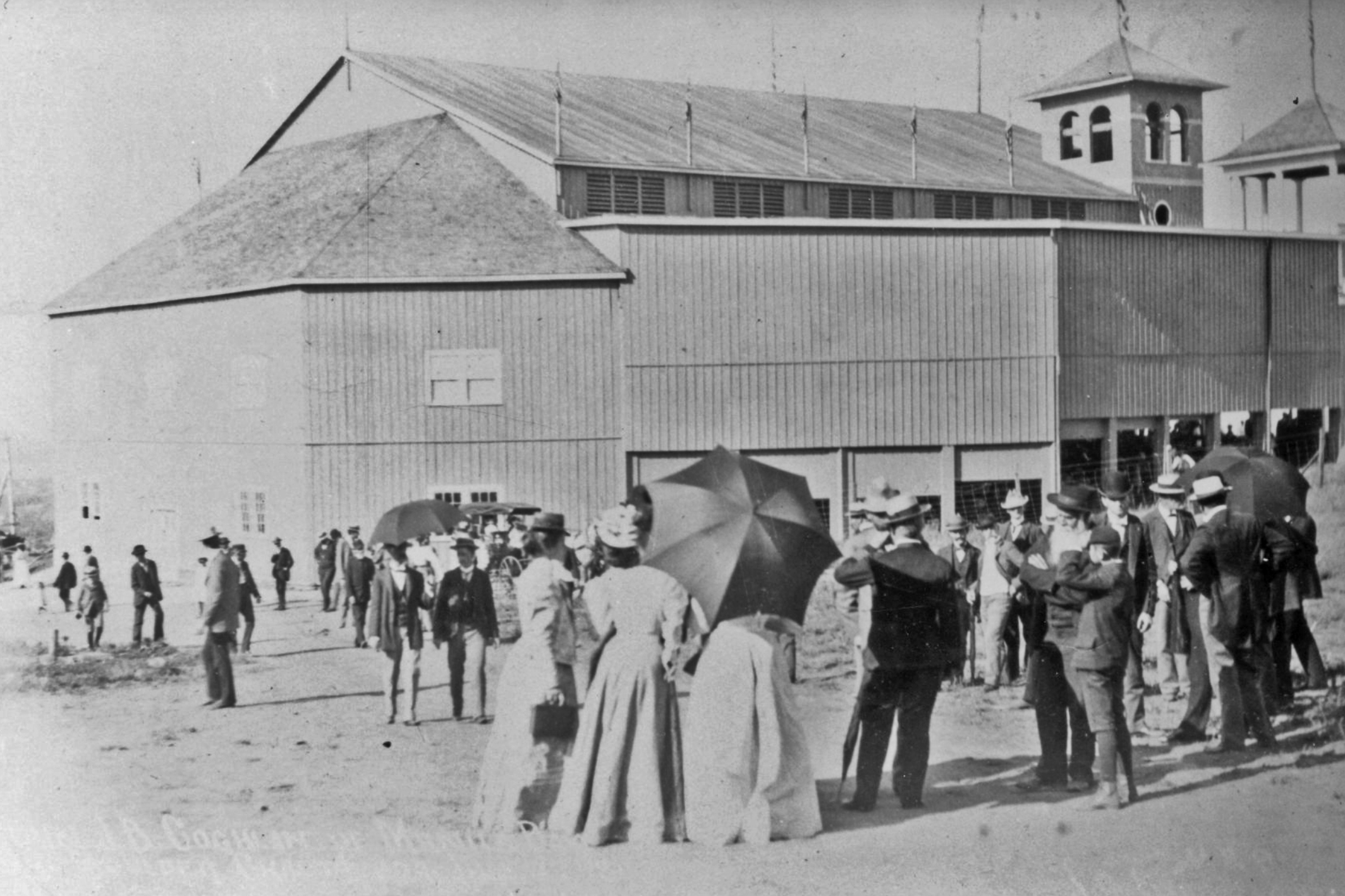
In preparation for the Sundance Film Festival, the Chautauqua Association recently remodeled its 1,300-seat auditorium for
year-round use. The work, however, had to be done quickly to make the venue available for summer events and concerts.
The race against time reflects the auditorium's original construction when it was constructed in only six weeks.
By the end of the nineteenth century, the Chautauqua educational and cultural movement had spread all over the country.
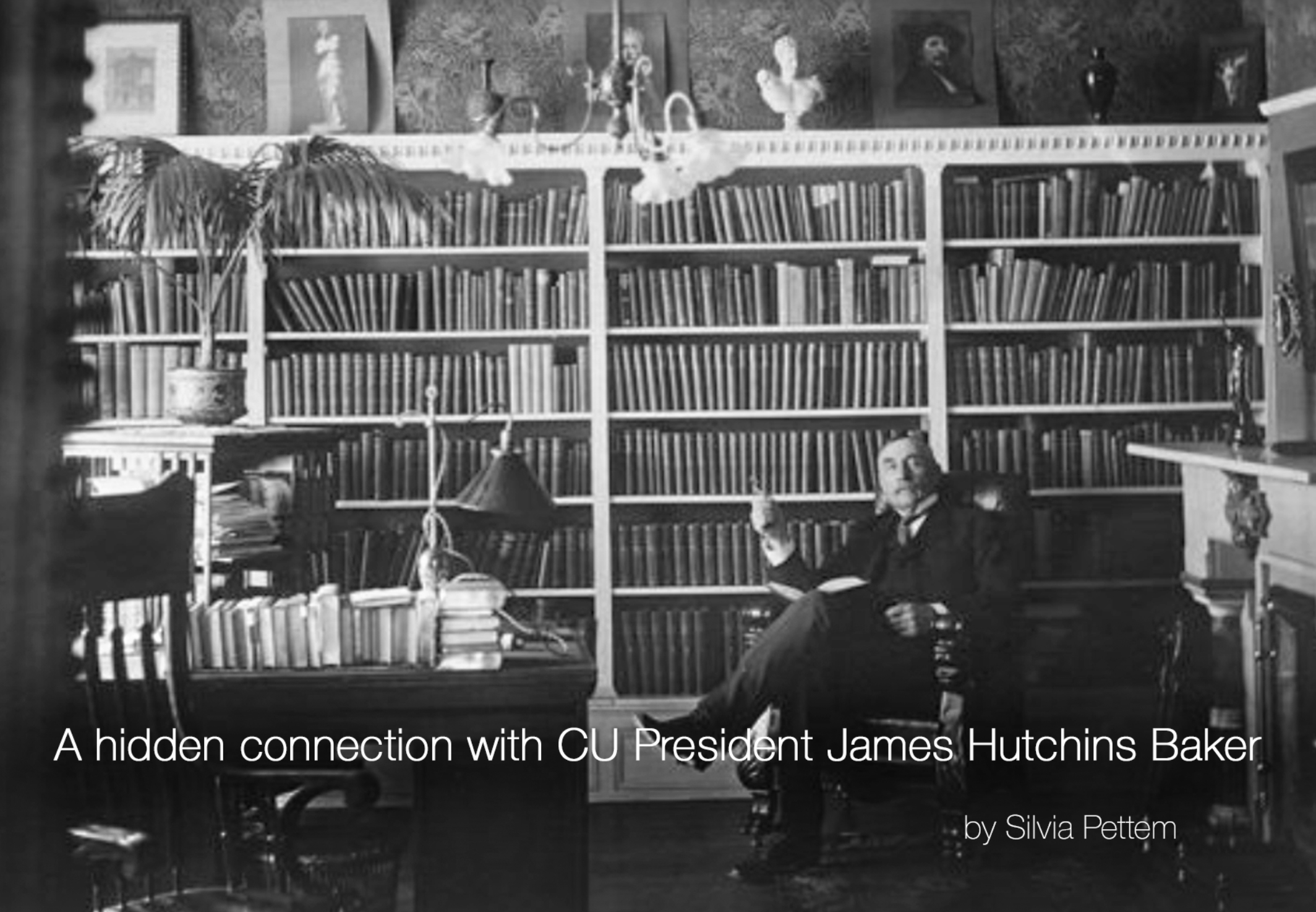
This year marks the 150th anniversary of the University of Colorado, founded in 1876. So, it's a good time to look at one of CU's early presidents, James Hutchins Baker. What makes Baker even more appropriate is that he and our own Jon Hatch share common ancestors, most recently David Williams Hutchins (1746-1822). Both Baker and Hatch have roots in Maine, and both moved to Boulder.
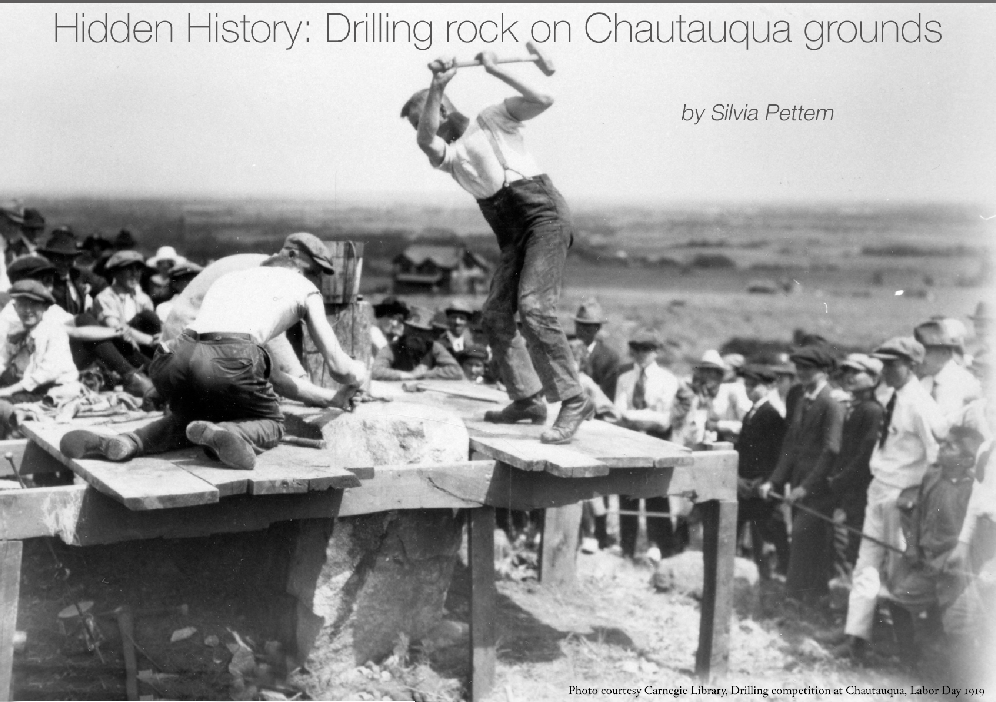
In the late nineteenth century, hard-rock miners uncovered vast quantities of silver and gold by hand. Then, drills that ran on steam-powered compressed air revolutionized the industry. The old-time miners, however, were proud of their skills and competed in hand-drilling contests long after their outdated tools were no longer used underground.
For the contests, miners took turns either "single jacking" (one man) or double jacking (2 men) on large granite boulders. Several of these events took place at Chautauqua, and one of the drilling rocks (with a brass plaque and visible drill holes) is to the left of the park's entrance road near its intersection with the road that exits the Chautauqua Green.
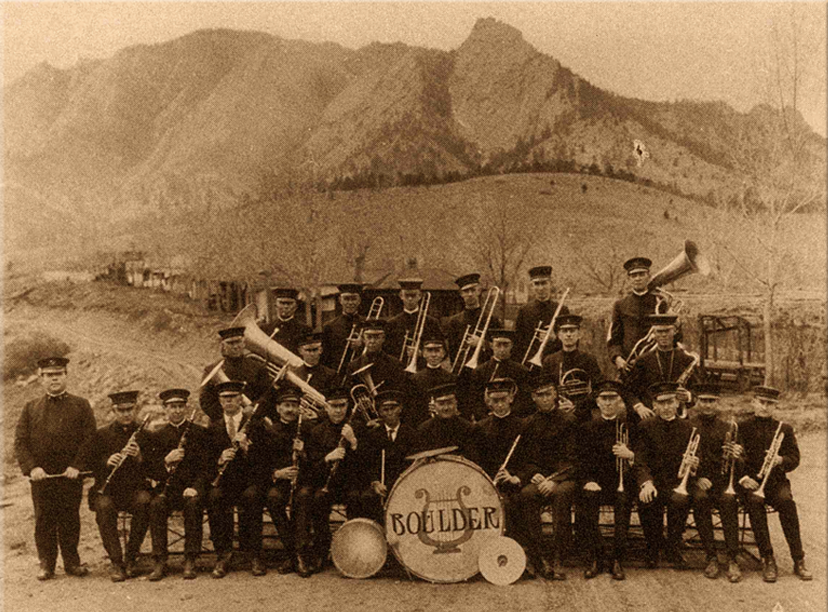
Boulder's Chautauqua was part of a national educational and cultural movement
that combined speakers, entertainers, and films. Visitors (including whole families) came from mostly southern and midwestern states to revel in Colorado's relatively cool summer nights.
In the 1920s, and depending upon one's point of view, Boulder's Chautauqua was known either as the “intellectual center of the West" or "a place to go when your brain needs a vacation.”
Astronaut Scott Carpenter was a Boulder native, chosen as one of NASA's original "Mercury 7"
astronauts and the second American to orbit the Earth. Some accounts state that he named his
"Aurora 7" space capsule after the seven astronauts and the word "aurora," to represent the first light of dawn.
He grew up, though, in a stately two-story brick house at 907 7th Street, on the northwest corner of
Aurora Avenue and Seventh Street. For Boulder residents, the space capsule's name seems more than a coincidence.
Other of Carpenter's Boulder connections are more down to earth, as his mother Florence, along with aunts, uncles, and grandparents are buried in Green Mountain Cemetery.

When Ethel and Marion Mann were young girls, their mother would invite dancers to dinner, then urged her guests to "teach the girls a few steps."
The sisters' journey to stardom began in 1926 when Ethel won a dance contest. The prize was a year of dance lessons in New York City. Ethel, her sister, and their mother all moved from Boulder to New York. After Ethel's classes, she taught Marion everything she had learned.
While in New York, they watched cowboys at rodeos in Madison Square Garden and learned rope tricks from "cowboy philosopher" Will Rogers.

Bluebell Avenue resident had unusual past,
By Silvia Pettem
In last month’s “On the Corner,” I wrote that early real estate developer David Dobbins built four almost-identical brick bungalows, one on each of the southeast corners of Bluebell Avenue and 15th, 16th, 17th, and 19th streets.
The house at 1604 Bluebell was owned by Miriam Rieder who lived there from the late 1930s to her death in 1957. Rieder was an assistant professor of Romance Languages at the University of Colorado. She also was considered an eccentric, and she had an unusual past.
At the time, acres of undeveloped property surrounded Rieder’s home. She bought the land and preferred it wild and unkempt with native plants and flowers providing a sanctuary for ground-nesting birds. After one neighbor complained of her “weeds,” she wrote a scathing letter to the editor of the “Daily Camera.”
“What is the matter with people who are so blind that they see beauty, and utility, only in their own little clipped lawn?” Rieder asked. “How can people go to church and sit in pews and worship God, and then devote their weekdays to trying to destroy what He has generously given us to enjoy?”
Rieder regularly patrolled her property and carried a pistol to scare off intruders. Parents of neighborhood children complained that she chased and shot at them. In 1950, the then-61-year old woman pleaded guilty in court to “threatening the lives of young people,” but she claimed she only did it to frighten them off of her land.
The public was unaware during her lifetime that Rieder was the daughter of former German professor Mary Rippon. At CU’s recent May Commencement, the highly acclaimed Rippon received a long-overdue posthumous honorary doctoral degree. But in 1889, she had secretly married one of her adult students, and they had a child. That child was Miriam Rieder.
Rippon conveniently took a year’s sabbatical to Germany where Rieder was born in 1889. Then Rippon returned to CU and continued to teach. The little girl was left in orphanages and passed around an extended family of aunts and uncles for the first few years of her life. Rippon (who would have lost her job if her marriage had been known) never lived with her husband. Eventually he remarried and was able to raise their daughter.
When Rieder lived at 16th and Bluebell, she was separated from her husband Rudolph. Their son Wilfred is now deceased, but he spent most of his adult life on the East Coast. Think of Rieder, her birds, and her unusual background, as you drive by her former home.
Cutline: Miriam Rieder’s former home at 1604 Bluebell Avenue was one of four (initially!) almost-identical brick bungalows built by real estate developer David Dobbins.
Silvia Pettem is the author of “Separate Lives: The Story of Mary Rippon,” available in local bookstores and at www.thebooklode.com.

Chautauqua a win-win for Boulder
by Silvia Pettem
Ever since 1898, Boulder residents and visitors have participated in events at Boulder's Chautauqua, now in its 125th year. But the national, cultural, and educational movement is not unique to Boulder. It grew out of nineteenth-century camp meetings in New York state and provided classes, oratory, music, and entertainment to isolated communities.
In its early days, there were at least 150 of these gatherings all over the country. So, how did Chautauqua, initially a summer resort, find its way to Boulder? A longtime Chautauqua secretary once stated that the Boulder location was chosen after a committee of leading Texas educators "set out like knights of old in the search for the Holy Grail." They thought Boulder was "the loveliest little city in America." Also, its summers were cooler than at home.
Boulder voters quickly approved a bond issue to buy seventy-five acres of land, then leased the land to what at first was called the Texas-Colorado Chautauqua. Contractors then scrambled to build the dining hall and auditorium, as opening day was scheduled for July 4, 1898. Carpenters finished the auditorium's framing on June 22.
Then, with only twelve days to go, 75 men worked around the clock to complete the walls, roof, towers, stage, and benches. A reporter called the construction "the fastest work ever known in Boulder." On opening day, flags waved and bands played.
Many of the guests came by train and stayed all summer. That first year, they slept in tents. In the evenings, a lively pace of orators, entertainers, and musicians performed on stage. These performers "rode the circuit," traveling by train to gatherings in other parts of the country. In the daytime, families were kept busy with burro rides, railroad excursions, and hikes in the mountains.
Boulder's location is unique, but the Chautauqua name is not. The Iroquois word has multiple meanings, including “a bag tied in the middle” or “two moccasins tied together." It describes the shape of Chautauqua Lake, in southwest New York, at the site of the movement's first (and ongoing) location.
In 125 years, the Chautauqua Auditorium has seen an array of speakers, magicians and animal shows, colorful dancers, persuasive actors, and nearly every kind of singer and musician imaginable. Classical music has come back in style, and the films that started the first year have never stopped. The site was a win-win situation for everyone, even the Texans.
Silvia Pettem can be reached at silviapettem.com

Bryan and Jones were early Chautauqua speakers
by Silvia Pettem
William Jennings Bryan and Samuel P. Jones were an unlikely pair on a speaking tour, but individually and together they roused crowds in Boulder during Chautauqua's early days.
The national educational and cultural resort opened its Boulder venue in 1898. Although audiences enjoyed entertainers, musicians, and films, they were riveted on speakers. Politics, religion, and anti-liquor sentiments dominated the stage.
William Jennings Bryan, a former U.S. Representative from Nebraska, was the most popular speaker in 1899. The Democrat was known as the "silver-tongued orator" and had run for U.S. president but lost against Republican William McKinley. Still, Bryan was well-liked in Boulder County and other mining districts of the West, as he supported the free and unlimited coinage of both gold and silver.
When he stepped off the train in downtown Boulder, he was greeted by thousands of well-wishers. A reporter wrote, “Cheersyells, hand-clapping, waving of hats and handkerchiefs, a roar of sound and a seething sea greeted the ear and the eye simultaneously."
Six additional trains brought crowds from Fort Collins, the mountain towns, and from Denver, temporarily doubling Boulder’s population. Stores closed at noon, and crowds lined Bryan’s carriage route as he was driven uphill to the auditorium on the Chautauqua grounds. Many people walked from the downtown depot, while others rented horse-drawn hacks or squeezed onto Boulder’s new electric streetcars. Colorado women had recently won the right to vote, and they made up a large part of Bryan’s audience.
At the beginning of the program, a band played “Hail to the Chief.” When the renowned speaker was introduced as “the next president,” men, women, and children burst into wild applause.
Another early speaker was Samuel P. Jones, who was an evangelical minister and anti-liquor crusader. He was known for being humorous and theatrical, but his message was a simple one of living a good life that was as sin-free as possible.
Both Bryan and Jones returned to Boulder in July 1905 for Jones/Bryan Day. By then Bryan had lost his second presidential election, but the people in Boulder still loved him. The audience gave him a standing ovation and deafening applause.
At the time, speeches went on for three or four hours, and the only seats in the auditorium were wooden benches. After listening to Bryan, Boulder Daily Camera editor L.C. Paddock wrote that the benches were "unthinkably hard," but "Bryan is the only man who ever rendered them tolerable to the spine."
